

MASAI ATTIRE

IDENTITY, HISTORY AND PRIDE

When you take part in a volunteering experience with Cooperating Volunteers in Africa, there are encounters that stay with you forever. One of them, without a doubt, is the first contact with the Maasai people. Their presence is imposing, moving, and sparks curiosity. But beyond their bearing and way of life, there is something that powerfully captures attention from the very first moment: their attire.

For the Maasai, clothing is not just an aesthetic matter. It is identity, language, tradition, and a way of expressing who they are and where they come from.

imani manyara JMz UTimlu0 unsplash

Who are they?

The Maasai are an indigenous people of East Africa whose traditional presence extends mainly across two countries:

Kenya (south of the country):

They live in the areas of the Great Rift Valley and its surroundings, especially in southern regions of Kenya such as Narok (near the famous Maasai Mara), Kajiado, and towards the border with Tanzania.

Tanzania (north of the country):

They are commonly found in the lands of northern Tanzania, around places such as Arusha, Manyara, Dodoma, and areas close to the Serengeti, Ngorongoro, and Lake Natron.

Wide Maasai region

Their traditional territory, known as Maasailand, stretches from southern Kenya to northern Tanzania, in a corridor of savannah and grasslands influenced by the Great Rift Valley.

The Maasai are usually semi-nomadic pastoralists, moving with their herds of cattle in search of pasture and water. For this reason, they do not always live in fixed traditional settlements; mobility is part of their historical way of life.

Places where it is most common to find them today

  • Maasai Mara (Kenya) — a region known for its homonymous nature reserve, and an environment where Maasai communities still live.
  • Amboseli (Kenya) — an area in the south, near Mount Kilimanjaro, with many Maasai communities around the national park.
  • Surroundings of the Serengeti, Ngorongoro, and Manyara (Tanzania) — areas where they traditionally herded livestock and where today there are still nearby Maasai populations or communities.


In summary, if you want to encounter the Maasai during your volunteering experience or travels, the most common option is to organise it in the regions of southern Kenya and northern Tanzania, especially in rural communities close to national parks and reserves where their culture remains alive.

In fact, at Cooperating Volunteers we have a programme to support the women and girls of a Maasai village, focusing on educational opportunities and self-sufficiency, helping the efforts to improve the local community and learning more about the Maasai Mara region and its culture.
paola blaskovic wpnem8FS5HE unsplash

Much more than a garment: a cultural symbol

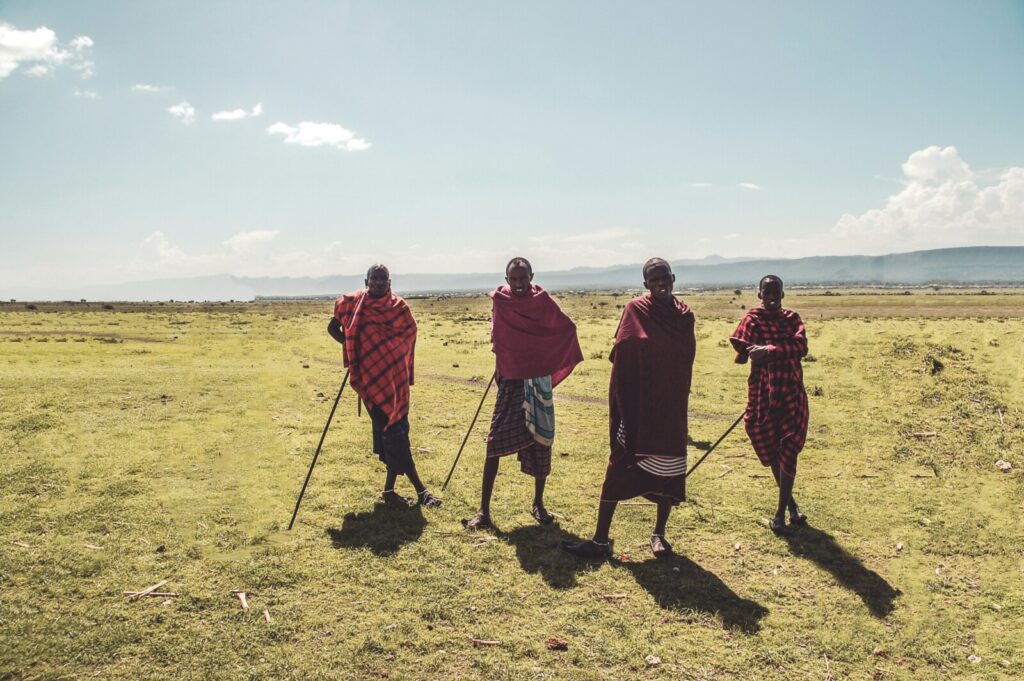
The most recognisable element of Maasai attire is the shúkà, that brightly coloured cloth, mainly red, that wraps around the body. Although today it is made with modern fabrics, its meaning remains deeply traditional.

The colour red is the most emblematic, and it is no coincidence. It represents bravery, strength, and protection, and it was traditionally believed to help ward off wild animals. In an environment where coexistence with nature has always been essential, every detail has a purpose.

In addition to red, other colours also appear, each with its own meaning:

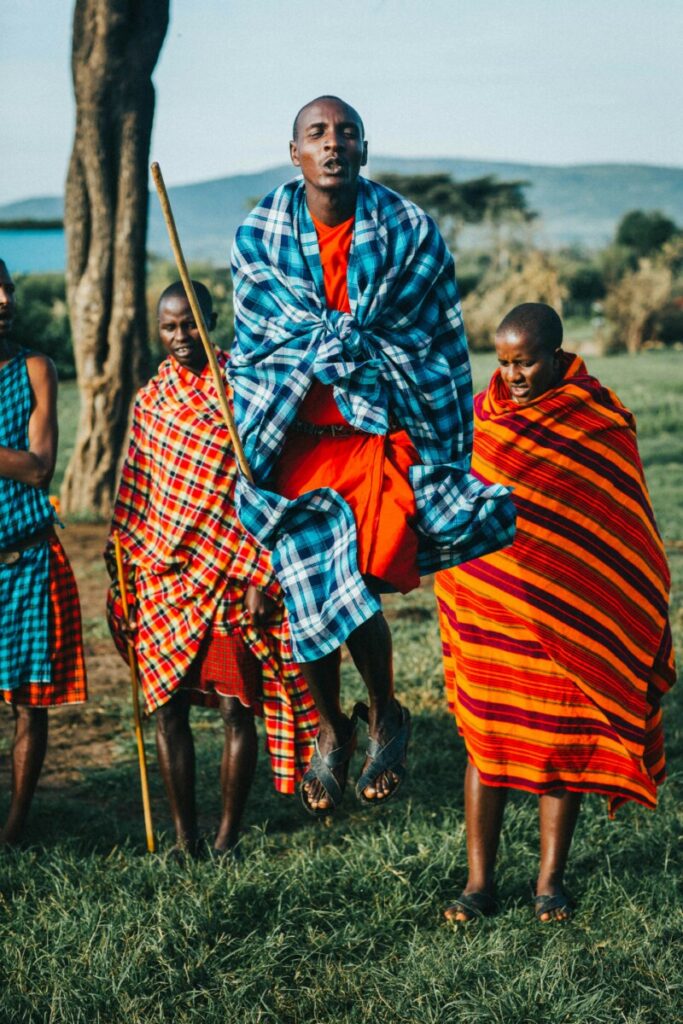
  • Blue, which symbolises the sky and rain, a source of life.
  • Green, associated with the land and prosperity.
  • Orange and yellow, linked to hospitality and energy.


Necklaces, bracelets, and beads: hand-crafted stories

One of the most fascinating aspects of Maasai attire is their handcrafted jewellery, especially that worn by women. Necklaces, earrings, bracelets, and headdresses made with colourful beads are not simple ornaments: they communicate marital status, age, role within the community, and even important moments in life, such as ceremonies or celebrations.

Each piece is made by hand, with patience and precision that reflect the value of craftsmanship passed down from generation to generation. During your volunteering experience, you will discover that many of these pieces of jewellery are made collectively, also becoming a space for gathering and cultural transmission.

Clothing that accompanies every stage of life

The way the Maasai dress evolves with age and social role. Young warriors, known as morans, usually wear more striking clothing and elaborate hairstyles, symbols of their strength and their transition into adulthood. Women, for their part, incorporate more jewellery as they move through the different stages of their lives.

Nothing is random. Every colour, every accessory, and every way of wearing it has a meaning that speaks of belonging and cultural pride.

A living tradition in a changing world

Despite globalisation and contact with the modern world, the Maasai people have managed to maintain their identity. Today, it is common to see a natural coexistence between tradition and modernity: sandals made from recycled tyres, shúkàs combined with contemporary garments, or traditional jewellery adapted to new styles.

This ability to adapt without losing their essence is one of the great lessons that many volunteers take with them after living alongside local communities.
ana singh 1vOBJZ6228U unsplash

Living it first-hand

For those who take part in Cooperating Volunteers programmes in countries such as Kenya or Tanzania, getting to know Maasai attire goes far beyond simply observing it. It is about understanding that clothing can be a form of cultural resistance, pride, and connection with history.

Spending time with local communities, learning the meaning of their colours, seeing how jewellery is made, or simply listening to the stories behind each garment turns this experience into a deep and transformative learning process.

Because in the end, the true journey is cultural, human, and emotional. And along that path, Maasai attire reminds us that identity is not lost when it is shared: it is strengthened.

Leave a Reply

Your email address will not be published. Required fields are marked *

Contact

Leave us your information and we will contact you within the next 24 hours

UNIVERSITY PRACTICES

Our volunteers will be able to validate university credits with the aim of traveling in a more responsible and economical way.

What does volunteering focused on university practices involve?

At Cooperating Volunteers, we make agreements with different universities to validate university credits with the aim of traveling in a more responsible and economical way.

The specialties we work with are extensive: medical volunteering, nursing, education, social work, psychology, physiotherapy, engineering, architecture…

The practices can be carried out in our designated destinations for this purpose, as well as in Spain.

If you choose an international destination, it’s a unique way to live an unforgettable and enriching experience, as you will have the opportunity to continue your education in another country, with a completely different culture.

Stepping out of our comfort zone and being part of the various projects at the destination will allow us to grow both personally and professionally, creating a more extensive curriculum.

And we are fully convinced that this experience will accompany you throughout your life.

You will be able to visit hospitals, schools, centers, orphanages, and participate directly and actively in the daily lives of all those people at the destination, always accompanied by other professionals willing to collaborate hand in hand with you and guide you in daily tasks.

If your university is not part of the agreement with Cooperating Volunteers, you can contact cristina@cooperatingvolunteers.com so that we can get in touch and make this experience a reality. 

CORPORATE VOLUNTEERING

Corporate volunteering consists of tailored programs for your company, designed to develop teamwork skills.

It is proven that teamwork directly impacts productivity. 

Collective effort surpasses individual capabilities, promotes diversity of skills, stimulates creativity, and facilitates problem-solving in the face of various challenges.

Therefore, it not only maximizes efficiency but also enriches the work environment.

We conduct corporate volunteering programs that consist of customized programs for your company, designed to develop teamwork skills, improve performance, and foster unity among employees.

We tailor projects to the corporate identity and size of the company, and we can adjust them to any destination and time of the year.

The advantages of corporate volunteering include:

  • Improving communication.
  • Group unity.
  • Cultural integration in different situations.
  • Employee training.
  • Increased Corporate Social Responsibility.

The future is aligned with a more responsible society, and participating in social projects positions our company among the list of revolutionary businesses that want to be part of the change.

If you resonate with this message, corporate volunteering is a unique experience both individually and collectively, and at Cooperating Volunteers, we accompany you throughout the process to make it a unique journey.

FAMILY VOLUNTEERING

Quality time spent with family strengthens emotional bonds, promotes communication, and contributes to the emotional well-being of its members. 

Spending quality time with family and being able to disconnect from our hectic routines is not only enriching but also necessary.

Sometimes we forget to communicate, connect, and dedicate time to each other. Each one of us lives focused on our jobs, schools… And it’s necessary to find the opportunity to pause and take care of ourselves.

Quality time spent with family strengthens emotional bonds, promotes communication, and contributes to the emotional well-being of its members. And of course, it creates lifelong positive memories.

At Cooperating Volunteers, we suggest moving away from those ‘more superficial’ trips (which can also be fantastic), but we invite you to live this experience to bring out our most empathetic and humanitarian side.

Family volunteering gives us the opportunity to be part of a positive impact, promoting values of solidarity and social responsibility.

There are many families who choose to experience these trips focused on cooperation and direct involvement with different communities around the world, where living conditions are very different and sometimes entirely precarious.

Projects are tailored to different ages, allowing us to work together.

An incredible way to fill our suitcase with memories, learning, and knowledge.

And although stepping out of our comfort zone often feels daunting, we assure you firsthand that it’s worth it.

At Cooperating Volunteers, we accompany you throughout the entire experience, from start to finish, to make it unforgettable.

SENIOR VOLUNTEERING

At Cooperating Volunteers, we believe it’s never too late for anything, especially for volunteering and living a unique and unforgettable experience.

There are many people, increasingly so, who opt for responsible travel that involves social work.

Accustomed to organized and mostly touristic trips, at Cooperating Volunteers, we want to advocate for a more enriching experience, one that transforms us from within and allows us to be part of the change the world needs to see.

We can adapt both the destination and the duration of our projects to fit your needs.

It’s an opportunity full of emotions that allows us to significantly contribute to different communities and their evolution. And you can participate in different areas such as education, social support, or assistance in different centers.

Some of the benefits include:

  • Sense of purpose: Provides a sense of purpose by contributing your skills and experiences to meaningful causes.
  • Emotional well-being: Reduces feelings of isolation and establishes social connections.
  • Personal development: It’s continuous learning, skill development, and discovering new activities while keeping the mind-body active.
  • Physical health: Keeping active.
  • Stress reduction: The act of helping others reduces stress and contributes to mental health.

Living this experience will undoubtedly be a before and after. 

SOCIAL VOLUNTEERING

A volunteering initiative with leadership and impact through the educational action program.

When we talk about social volunteering, we refer to all those actions and activities carried out altruistically, selflessly, and with the aim of addressing multiple problems and needs of different communities, always focused on education and self-sufficiency.

Education is essential because it provides the tools and knowledge necessary for personal, social, and economic development.

Our goal is to create self-sufficient communities and provide opportunities for the future personal development of each member. The message is not to ‘give’, but to accompany in the process of training for self-managed provision.

At Cooperating Volunteers, many of our destinations and projects embrace this type of volunteering. Some of our projects include: community programs, education, women’s empowerment…

And although they are completely different from each other, they share a single objective: progress towards a society that can embrace us all in the same way.

If you are someone who is restless, who needs to see a change in the future, volunteering is an experience tailor-made for you.